


Antikythera is a small Greeke island, located in the Aegean sea. Its remotely located between Crete and the Peloponnesian peninsula, and its known for its steep cliffs and sparse vegetation. In the beginning of the 20th century, the waters around the island, could be seen as the center of one of history’s more significant archaeological discoveries.

In the spring of 1900, a group of sponge divers from the Greek island of Symi stumbled upon a discovery that would baffle scientists and historians for over a century. These, led by Elias Stadiatos, were exploring the waters around the small island of Antikythera.
Diving into the azure depths near the island, one of the crew members encountered something spectacular: a seabed strewn with bronze and marble statues, pottery, and other remnants of an ancient shipwreck. These artifacts, resting at a depth of about 45 meters (150 feet), were part of a Roman-era cargo ship believed to have sunk around 60 BCE. Recognizing the historical importance of their find, the divers reported it to the Greek authorities, sparking a recovery operation led by the Hellenic Navy.
Over the next two years, archaeologists and divers painstakingly retrieved numerous artifacts from the site. Among the recovered treasures were exquisite sculptures, coins, and jewelry. However, the most enigmatic item was a corroded, lump-like object that, at first glance, seemed unremarkable. This item would later be identified as the Antikythera Mechanism, a device that would reshape our understanding of ancient technology.
The Mechanism: An Ancient Technological Marvel
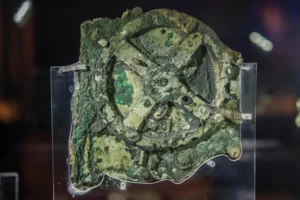
The Antikythera Mechanism is often today hailed as the world’s first analog computer. Dating back to the 2nd century BCE, it was designed to predict astronomical positions, lunar phases, and eclipses with remarkable precision—functions akin to the complex timekeeping and calendrical systems found in antique clocks. Constructed primarily from bronze and housed in a wooden case, the Mechanism consists of a complex arrangement of interlocking gears and dials, with inscriptions detailing its functions.
When it was first examined, the Mechanism’s corroded state obscured its true nature. It wasn’t until 1902, when archaeologist Valerios Stais noticed the presence of gears embedded within the artifact, that its mechanical complexity was recognized. Subsequent studies revealed its sophisticated design, which included at least 37 gears—an astonishing feat for its time.
Description of the Mechanism
The Antikythera Mechanism is divided into several key components, each serving a specific purpose:
- Front Dial: The primary dial displayed the zodiac and a 365-day solar calendar. It also included pointers for the positions of the Sun and Moon relative to the Earth, allowing for precise tracking of their movements. This feature aligns closely with the intricate mechanisms seen in antique astronomical clocks, which often integrate celestial tracking.
- Back Dials: The back featured two prominent spiral dials. One tracked the Metonic cycle, a 19-year period after which the phases of the Moon repeat on the same days of the year. The other indicated the Saros cycle, a period of approximately 18 years used to predict eclipses. Similar to the perpetual calendars found in antique clocks, these dials offered long-term predictive capabilities.
- Gear System: The Mechanism’s intricate arrangement of gears, some as small as a few millimeters, included an epicyclic gearing system that simulated the elliptical orbits of celestial bodies. A pin-and-slot mechanism accounted for the Moon’s variable speed as it traverses its orbit. These features mirror the gear-driven precision found in antique mechanical timepieces, where interlocking components ensure accurate motion.
- Inscriptions: Detailed inscriptions, visible on the surviving fragments, served as user instructions and provided astronomical data. These texts reveal a deep understanding of celestial mechanics and were likely intended to educate and guide the Mechanism’s user, much like the instructional engravings and markings found in antique clocks designed for educational purposes.
A Precursor to Complex Mechanical Clocks
The Antikythera Mechanism is a precursor to the complex mechanical clocks that would emerge in Europe over a millennium later. Its intricate gear systems, astronomical functions, and ability to model celestial phenomena draw direct parallels to the finest antique clocks crafted during the Renaissance and beyond.

Moreover, the educational and practical functions of the Mechanism resonate with the purpose of many antique clocks. Just as Renaissance-era clocks were designed to demonstrate the harmony of celestial and terrestrial movements, the Antikythera Mechanism served as both a scientific tool and a testament to the intellectual achievements of its creators.
The Mysteries of the Mechanism
Despite extensive research, the Antikythera Mechanism continues to pose numerous questions. Who built it, and for what purpose? How was such intricate technology developed in an era largely defined by rudimentary tools?
Some scholars attribute the Mechanism to the Hellenistic period, a time of intellectual flourishing following the conquests of Alexander the Great. Its design has been linked to the work of Greek mathematicians such as Hipparchus and Archimedes, though no definitive evidence connects it to a specific individual or workshop.
The shipwreck’s cargo also provides clues about its origins. Many of the artifacts suggest a connection to the eastern Mediterranean, with potential links to the island of Rhodes, a renowned center of astronomy and mechanical innovation. The Mechanism’s inscriptions, written in ancient Greek, further support this hypothesis.
However, the context of its creation remains shrouded in mystery. The level of sophistication evident in the Mechanism suggests a long tradition of mechanical experimentation, yet no other artifacts from the period exhibit comparable complexity. This has led some to speculate that the Mechanism represents a unique and isolated achievement, perhaps the work of a single genius or a specialized school of thought.
The Legacy of the Antikythera Mechanism
The rediscovery of the Antikythera Mechanism has profound implications for our understanding of ancient science and technology. It challenges the conventional narrative that advanced engineering emerged primarily during the Renaissance, demonstrating that ancient civilizations possessed knowledge and skills that rivaled those of much later periods.
Modern studies, aided by advanced imaging techniques such as X-ray computed tomography, have uncovered previously hidden details of the Mechanism’s structure and inscriptions. These findings have enabled researchers to reconstruct its design and function, offering a glimpse into the intellectual achievements of the ancient world.
Beyond its technical significance, the Antikythera Mechanism serves as a symbol of human curiosity and ingenuity. Its discovery, in the depths of the Aegean Sea, reminds us of the enduring legacy of ancient knowledge.
You can read more about the Anikythera Mechanism at Wikipedia